MediaJustice brings AI governance fight to Oakland with screening of ‘Ghost in the Machine’
on October 4, 2026
For Oakland, AI governance isn’t an abstract and distant policy debate but an urgent issue. Positioned in the backyard of Silicon Valley, Oakland has become attractive to tech companies: from a proposed data center downtown to AI manufacturing startups and Tesla robotaxis in West Oakland’s historic American Steel Blocks building.
Technology expansion could reshape land use, power grids and municipal resources. Ensuring local control was a key topic at Oakland Tech Week, which wrapped up over the weekend, after a series of workshops and discussions on how technology can strengthen local businesses and neighborhoods. The event also featured the screening of “Ghost in the Machine,” a documentary by Valerie Veatch that functions as a profound explanation of the invisible machinery supporting artificial intelligence.
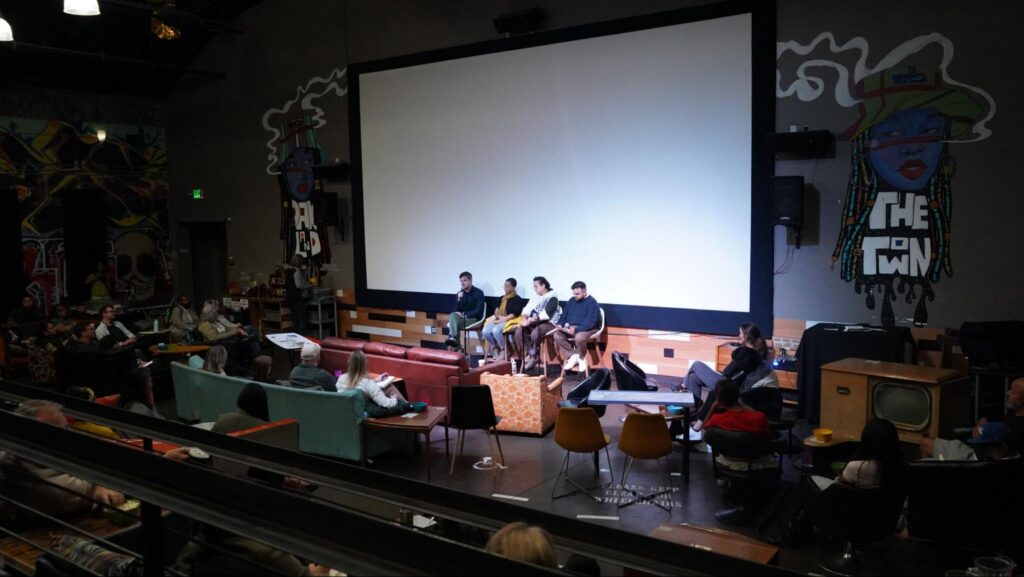
One in the couch-filled New Parkway Theater, about 100 people joined a panel discussion alongside local tech and media justice leaders before the screening on Sept. 29. They discussed how underserved communities can govern AI’s footprint so that automated systems aren’t imposed on them.

”The last 20 or so years of Silicon Valley has proven to us that they cannot be trusted to actually make decisions that are in the best interest of most people, because given the choice between building technologies that further harm our planet and our people in order to make profit or to better humanity, they’ve always chosen the path of profit,” Steven Renderos, executive director of MediaJustice, the event’s organizer, said in an interview before the screening.
The film, which premiered this year at the Sundance Film Festival and also aired on PBS, traces the origins of AI to eugenics, scientific racism, and WWII-era fantasies of machine-extended power. It highlights how the Nobel Prize-winning Silicon Valley pioneer William Shockley and his students at Stanford embedded eugenicist ideologies into the foundations of tech culture, treating technological development as an attempt to control creation itself. The film asserts community governance holds immeasurable power when people know how to exercise it.
Renderos moderated the three-person panel, which included Thema Monroe-White, associate professor of artificial intelligence and innovation policy at George Mason University in Virginia; Alex Hanna, sociologist and research director at the Distributed AI Research Institute in Oakland; and Sam Biddle, a senior technology reporter at The Intercept. They discussed the motivations of AI doomers and boosters, the power of AI in military operations and the conception that technology is built “for the best of humanity.”
Biddle emphasized AI’s potential to cause death isn’t a distant threat — the U.S. military currently relies on it to guide its assaults.
“There’s nothing artificial and there’s nothing intelligent about artificial intelligence,” said Monroe-White, who is featured in the movie discussing her work to dismantle eugenics thinking via data. “We need to understand who we are fighting against.”
The debate is at the forefront in Oakland, where community groups have launched “No Data Center” campaigns. City Councilmember Carroll Fife recently introduced a 45-day moratorium on data center approvals to study their environmental, noise and utility impacts. The City Council is expected to vote on Fife’s proposal Tuesday.
“Moratoriums actually, for me, are a really effective thing to channel a lot of people’s sense of overwhelm and sense of anger over what’s not working. Because it does one very valuable thing for people, which is to slow the process down,” Renderos said.
The pause would give the community time to ask: What economic development does Oakland need? What jobs will last beyond the short-term construction phase? What community do Oaklanders envision?
About half the people in the theater stayed after the screening to continue the discussion.
Hanna, who wrote “The AI Con,” argued that tech developers appear comfortable with the technology causing deadly harm, so long as it targets only marginalized groups.
There was much for viewers to discuss about Veatch’s film, which also exposed examples of oppression, such as Kenyan data workers who earn less than $1 an hour to filter disturbing content online, data centers being built in communities facing water scarcity, and Elon Musk’s high-consumption data centers being built in predominantly Black U.S. neighborhoods.
The documentary suggested that technology does not have the power over people. It conveys that having self-governance means being able to say ‘no’ and to make choices.
“Ghost in the Machine” is available for free on YouTube.

New law puts West Oakland coal project in limbo

Oakland North welcomes comments from our readers, but we ask users to keep all discussion civil and on-topic. Comments post automatically without review from our staff, but we reserve the right to delete material that is libelous, a personal attack, or spam. We request that commenters consistently use the same login name. Comments from the same user posted under multiple aliases may be deleted. Oakland North assumes no liability for comments posted to the site and no endorsement is implied; commenters are solely responsible for their own content.