With Oakland policy shift, losses mount for people who live in vehicles
on April 27, 2026
Jose De Jesus Gonzalez Ibarra carries the traces of his identity in a manila folder. He pulls out each piece of paper with care, almost as if he were handling the real thing. Splayed in front of him are creased photocopies of the green card, passport, and Social Security card he lost in a recent sweep of his trailer., which was parked under a maze of highways in West Oakland.
Gonzalez, now 45, has been unhoused for 23 years. His ultimate dream is to have what he calls a normal life: a job, a home, a family. All made difficult without the documents he needs to achieve the first item on the list.
The Oakland Department of Transportation tows approximately 2,500 vehicles a year, with vehicle encampments being a main area of focus. As of 2024, more than half of surveyed unsheltered people in Oakland sleep in their vehicles, effectively making vehicle policies, homelessness policies.
In Oakland, vehicles are just as prominent as tents. At one encampment, at the end of Fourth Street and tucked below Interstate 880, trailers and RVs line the perimeters of the community, flags poking from the roofs of some, adding color to the cluster of unofficial shelters.
On April 14, City Council member Ken Houston succeeded in repealing the previous Encampment Management Policy and replacing it with the 2025 Encampment Abatement Policy. This changes protocol involving vehicles by explicitly excluding them from being considered living spaces, facilitating their removal, and falling in line with Oakland’s trend of increasing encampment closures in recent years. It does include a caveat that instructs staff to avoid towing vehicles that have children.
Before the policy passed, the council agreed on amendments pitched by Councilmembers Zac Unger, Charlene Wang, Rowena Brown, Carroll Fife and Council President Kevin Jenkins. These include requiring the city to thoroughly document information from closures and towings, such as resources expended, race, age and other demographic information about the residents effected, and number of residents offered alternative shelter. In addition, the council asked the city to provide more resources to those residents such as safe parking sites and information about available services and shelter in Alameda County.
The policy also requires an analysis of city-owned properties that could be used for shelter, safe parking and vehicle storage. It passed in a 5-1 vote, with Noel Gallo voting no, Fife abstaining and Janani Ramachandran absent. There were nearly 60 public speakers on the item, with a majority objecting to the policy.
Houston later said he thinks the policy will help those living in vehicles because they now will be directed to specific locations where they can be offered shelter and other services.
Still, the question remains about whether removing vehicles from the encampment policy instead creates more barriers for unhoused residents, such as the barrier that Gonzales now faces.
From Pipe City to the present
Oakland’s relationship with its unhoused community spans nearly a century. “Pipe City,” a Hooverville of nearly 200 men who took shelter in surplus concrete pipes on 19th Avenue, emerged in 1932 as the first notable homeless encampment in Oakland. The city offered to house the men in a public building, but the men said they didn’t want to be bound by the city’s regulations. So rows of large gray cylinders were used as living spaces until they were sold in 1933.
Today, the city continues its attempts to mitigate homelessness, with varying results. In 2019, Oakland introduced a PATH (Permanent Access to Housing) framework to prioritize prevention and intervention, with the goal of “significant reductions in the numbers of people who experience homelessness each year.” Homelessness has instead increased by approximately 35%, according to the latest available Point In Time Survey.

Advocates argue that this is in part due to the misdirection of resources, with focus being placed on encampment closures rather than alternatives such as sober housing facilities or safe parking programs. The 2020 Encampment Management Policy facilitated closures by designating camps as being in high or low sensitivity zones. High-sensitivity zones are where health and safety impacts of encampments are heightened, making them subject to sweeps. These include areas near parks, schools, homes, protected waterways and businesses. High-sensitivity zones make up a majority of encampment classifications, according to city data.
Changes made in the 2025 policy explicitly exclude any type of vehicle, even if inhabited, from the definition of encampment. In a document outlining the shift, areas in the old policy where “vehicle” was followed by the word “dwelling” are struck through.
Kelsey Hubbard, a local unhoused organizer, has been present at vehicle sweeps that happened under the previous policy, watching as people lost everything in a single moment. Hubbard was there when Tena Harvey, formerly unhoused, had her truck towed last November. In it were Narcan, wound care, drug testing kits, condoms and other harm reduction supplies that Harvey and Hubbard were distributing to unhoused communities across Oakland.
When Hubbard and Harvey told the officer who swept the truck what they would be losing, she was initially sympathetic, saying that she would call the tow company and get the supplies back. But that never happened, Hubbard said.
Harvey told her side of the story as she methodically laid out the replacement harm reduction supplies on a foldable table at one of Wood Street Commons’ weekly outreach events. Harvey, like Gonzalez, previously lived at Wood Street Commons, once home to approximately 300 people, making it the largest unhoused encampment in Northern California while active. She was there when it was swept in 2023, and now lives in a tiny home on 23rd Street and San Pablo Avenue, where her truck was towed from.
“I’m housed, and they’re still sweeping me?” she said, her hands outstretched. Harvey’s vehicle was unregistered, which is why it could be towed.
Hubbard believes registration has become more of a target than it was before Houston proposed the new policy. During a recent encampment closure, she saw the RV of a man she knew get swept. That same RV, though unregistered, had survived two previous sweeps, said Hubbard, who wondered why city crews hadn’t acted sooner if they thought the vehicle was a problem. “It’s just like, well, it’s been unregistered. You’ve been around this vehicle while it’s been unregistered,” she said. “Why are you making the call all of a sudden now?”

The main thing Gonzalez remembers about the day his trailer was taken is that they didn’t wait. His brother was there when it was lifted, calling Gonzalez immediately and telling him to head back from visiting their other brother in East Oakland.
Gonzalez’s brothers are the reason he has residency documents in the first place. When he was shot and left in a coma while working at a Merced dairy factory in his 20s, they took action to file for a UVisa, which is granted to victims of violent crimes.
Gonzalez came to the U.S. from Mexico when he was 15, crossing the border with financial help from his brothers, who were already living here. This time, there was nothing they could do for him. When Gonzalez arrived, his trailer was gone, and so was everything inside.
“There weren’t any police officers. Nothing. They didn’t tell me where it was, or what I was going to do, or what I needed to do. Nothing,” Gonzalez said in Spanish.
He found out where the trailer was through a friend who had seen it in an impound lot near 66th Avenue and Coliseum Way, but since identification — which was inside his trailer — is required to retrieve towed vehicles, Gonzales felt discouraged from trying to get it back.
Bay Area attorney Deanna Mouton, who takes cases involving homelessness, has been filing property claims on behalf of unhoused clients who have been swept, focusing most recently most recently on losses resulting from towings. She said Oakland often asks for additional evidence that is difficult for her clients to have gathered before the sweep. The people she works with often aren’t thinking about cataloging every item they might lose.
“They’re focused on finding a place to live, focused on surviving,” she said.
At the moment, Gonzalez is focused on staying clean. Four months sober from crystal meth, he is trying to hold himself accountable at Alcoholics Anonymous meetings. He has not yet been able to start the process of replacing the documents.
“It’s not that one is lazy, it’s that sometimes things get in the way,” he said. “Like for me, I have to be in meetings.”
He also has to find a new place to live, now that his vehicle is no longer an option. That hadn’t been his primary residence. Gonzalez had been placed in a tiny home shelter on Third and Peralta streets in West Oakland when Wood Street was swept, but after learning the shelter would be shutting down in May, he moved to his brother’s couch
Graham Pruss, an anthropologist at the National Vehicle Residency Coalition, explained that often people in tiny homes still use their vehicle as a living space.
“There’s a lot of personal investment into the vehicle, not just monetary, but in crafting it into a home and into a space that is safe and comfortable,” Pruss said. Even when people are offered shelter, they often perceive vehicles as more stable, not wanting to trade them for one that is subject to closure by the city or the organizations that run them, he added.
In California, there are no laws that criminalize homelessness. But with policies such as the one Oakland has instituted, unhoused people are losing protections, said Laura Riley, assistant dean of Clinical Education at Berkeley Law and a member of the American Bar Association’s Commission on Homelessness & Poverty. People in situations like Gonzalez’s also are being cut off from economic opportunity by not having what they need to do things like apply to jobs or public programs, she said.
In his resolution, Houston cited the Supreme Court’s 2024 decision that prohibiting public camping without offering an alternative was not a violation of the Constitution’s “cruel and unusual punishment” clause. In the year after this ruling, encampment sweeps in Oakland increased by more than 600%, according to city data. Riley predicts this policy will not reduce homelessness in Oakland.
“I think sometimes policymakers are operating in an abstraction where they’re sort of displacing people without any solution,” Riley said.
Riley and Pruss say that instead of focusing on policies that lead to displacement, the city should allocate resources to things such as safe parking programs and access to essential services. However, a safe parking program on 71st Avenue is facing closure this year due to budget constraints.
A majority of low-sensitivity zones in Oakland are in Council Districts 3 and 7. Houston says there will be an increase in low-sensitivity zones across all districts under the new policy. These low-sensitivity zones have not yet been established, but the city administrator will identify potential areas for new shelters or low-sensitivity zones. Jenkins also added a clause that will give the city administrator, along with the council member of the affected district, authority to reclassify areas for purposes of enforcement and intervention.
Houston offered an example of how that might work in his district. “Say, for instance, by your house. And you and your neighbors consider it a high sensitivity area, and we go over, and we understand it. I’ll talk to the city administrator, and he can turn that into a high-sensitivity area.”
Oakland North received no responses after reaching out to the city’s Transportation and Police departments, and public information office for comment.

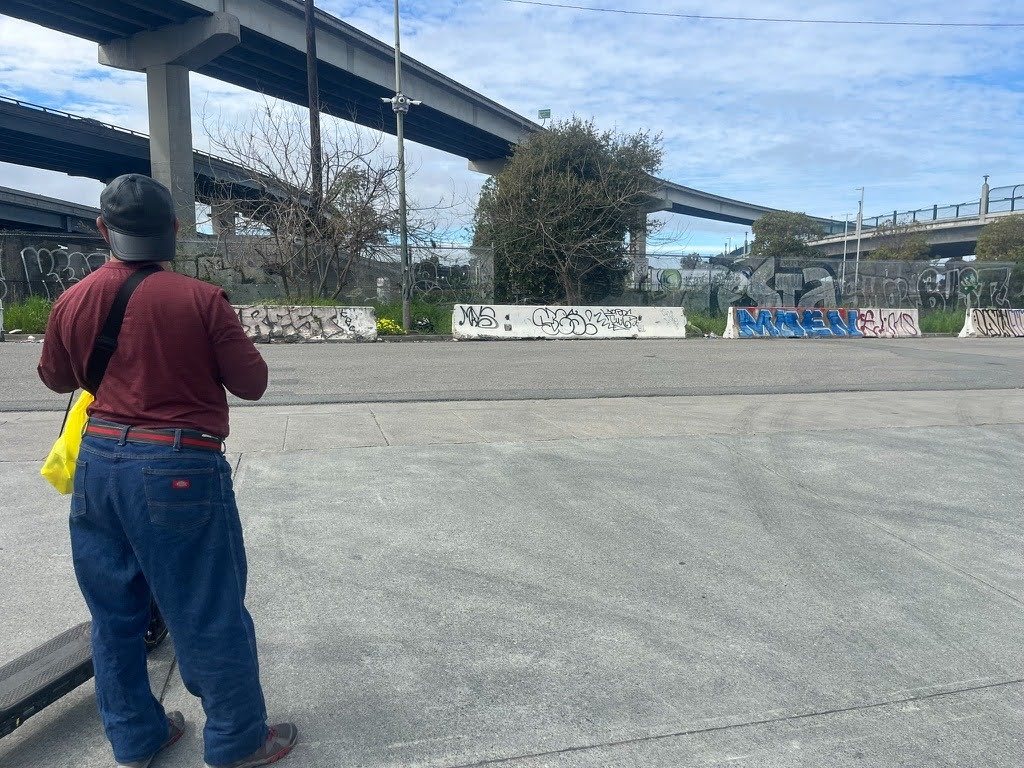
In March, Gonzales visited the spot where his vehicle had been parked until about six months earlier. City data shows two encampment closures there in September. Riding in on a scooter, Gonzalez walked along Beach Street until he reached a dead end. He pointed to graffiti-covered cement blocks that were lined up to discourage people from parking in that area again.
Gonzalez’s motivation to move forward stems in part from the night he decided to get clean. He didn’t tell anyone where he would be going when he ordered an Uber to an addiction treatment center in Castro Valley.
His Uber driver spoke Spanish, and when Gonzalez told him his story, the driver was encouraging, telling him he would conquer his addiction and “salir adelante,” meaning he would get ahead. The driver gave him a bracelet etched with encouraging words such as “persistence” and “wisdom,” the word “declaro” or “I declare” in larger text at its center. Gonzalez wears the bracelet every day, now using its encouragements to start the process of replacing his documents so that he can get a job and continue his sobriety.
He has connected with a housing navigator, who is trying to help him find a better living situation. She suggested he talk to an advocacy group in San Francisco that might be able to help him replace his legal documents. Gonzalez listened but found the task daunting, given the distance and the language barrier. He remains unable to prove that he is documented.
(Top photo: Jose De Jesus Gonzalez Ibarra eyes where his trailer was parked, by Nicolle Delgado)
‘Why would you all do this to me?’ asks man whose makeshift cabin was taken in Oakland sweep. ‘I literally needed somewhere to sleep.’


Oakland North welcomes comments from our readers, but we ask users to keep all discussion civil and on-topic. Comments post automatically without review from our staff, but we reserve the right to delete material that is libelous, a personal attack, or spam. We request that commenters consistently use the same login name. Comments from the same user posted under multiple aliases may be deleted. Oakland North assumes no liability for comments posted to the site and no endorsement is implied; commenters are solely responsible for their own content.