Lisjan Nation lore inspires new show at Fairyland Puppet Theater
on September 18, 2026
This story was co-published with The Oaklandside.
Before it was a puppet show, “Hummingbird Saves Fire” was a memory.
For Deja Gould, historical preservation officer and language keeper for the Lisjan Nation, it was a ritual of her childhood — falling asleep to her mother’s voice explaining how fire came into this world. She recalled her mother using different voices to distinguish each character, and how the detail was so vivid, it felt like she was really there.
Now Gould has helped adapt the story as a puppetry show for Children’s Fairyland in Oakland, part of a larger collaboration among Fairyland, the Lisjan Nation and the Sogorea Te’ Land Trust. “Hummingbird Saves Fire,” an adaptation of the Lisjan fire creation story, will premiere Sept. 30 and run through Nov. 29.
When Maria Rodriguez, lead creator with Fairyland’s Puppet Theater, first heard about the idea of adapting a Lisjan story, she asked if there was a written version of a tale that she could use as the basis for a live production. Instead, she said, the Lisjan Nation brought in a storykeeper to recount it orally.
“I saw the visual dynamics of fire,” Rodriguez said. “I could see how it would work as a puppet show.”
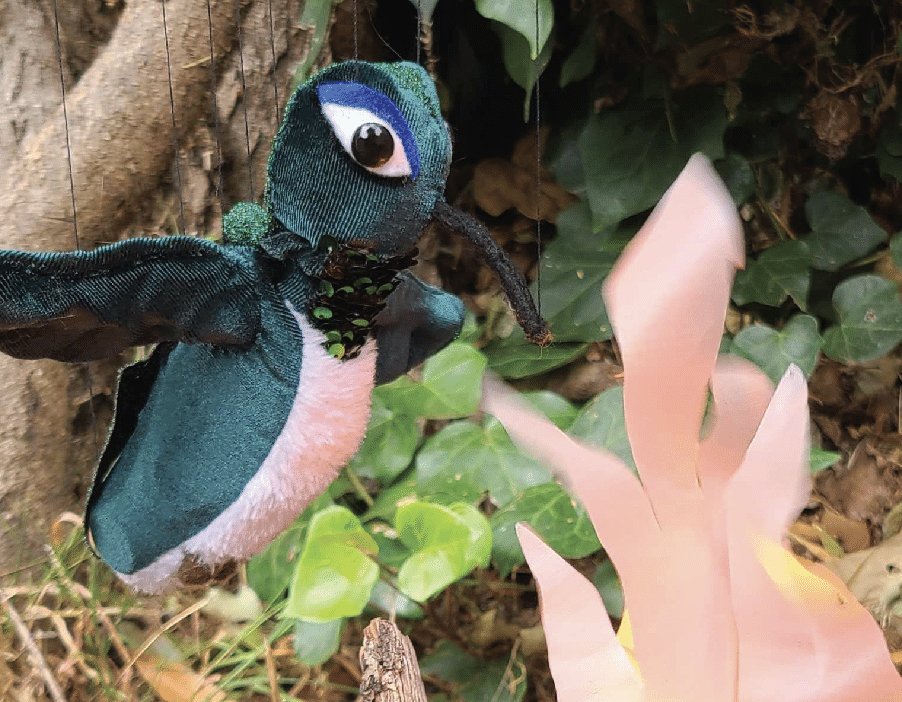
The intimacy of a story preserved in memory drew her in, Rodriguez said, and she thinks it will draw in audiences too.
The Sogorea Te’ Land Trust, based in Oakland, is an Indigenous women-led organization that works to return land to Indigenous stewardship in the East Bay. They work specifically with the Lisjan Nation, which is a confederation of Ohlone, Bay Miwok, Plains Miwok, Delta Yokut and Patwin peoples, whose ancestral territory spans five Bay Area counties: Alameda, Contra Costa, Solano, Napa and San Joaquin.
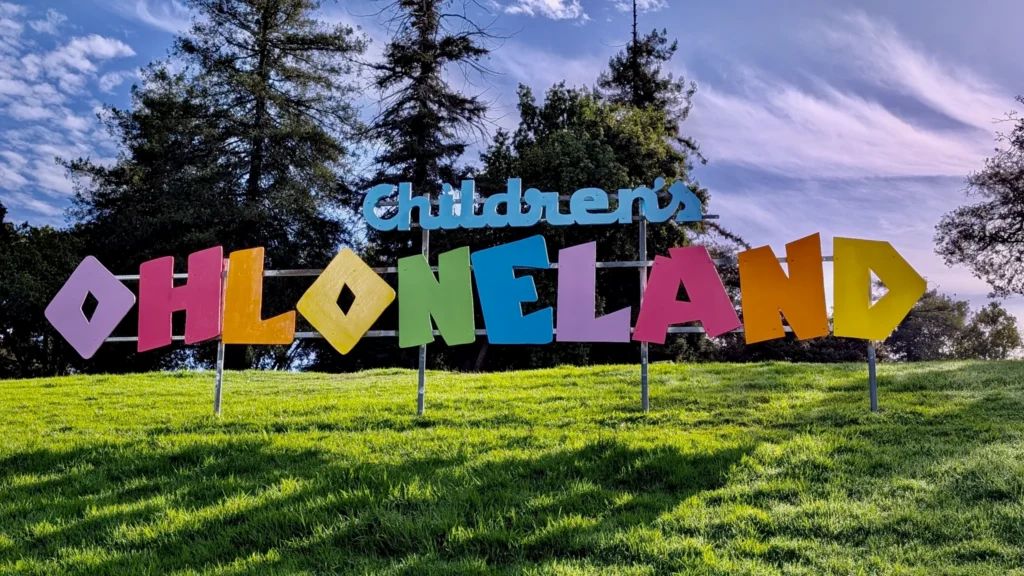
The partnership between Fairyland and the Lisjan Nation dates to 2024, after Sogorea Te’ Land Trust creative Director Ines Ixierda posted a social media image that altered Fairyland’s entrance sign to read “Ohlone Land,” to bring attention to the history of the land the amusement park occupies. The post circulated widely and eventually reached Fairyland staff.
“It ended up getting back to Fairyland, of course, and we just fell in love with it,” Rodriguez said. “We’re like, ‘We want to do this every year. We want to make their Photoshop a reality.’”

“Hummingbird Saves Fire”
When: 11 a.m., 2 p.m. and 4 p.m., Sept. 30 to Nov. 29
Where: Children’s Fairyland, 699 Bellevue Ave, Oakland
Admission: Children $18 $20 adults
Information: Fairyland.org
The image eventually took life as an installation at the park; the altered sign has been displayed each fall beginning around Indigenous Peoples’ Day since 2024.
From there, the work expanded into discussions about Fairyland programming and curriculum, which eventually led to the Puppet Theater stage. Ixierda said the focus shifted from a one-time gesture to an ongoing collaboration to include Indigenous-led stories in the institution’s work. That has included adding Indigenous educational elements to Fairyland’s curriculum, exploring ways to expand park access for Indigenous communities and, most recently, developing puppet shows based on Lisjan stories.
Ixierda said the area Fairyland occupies was central to those conversations. It sits by Lake Merritt, which was once marshland that bordered Lisjan villages. Earlier versions of the Hummingbird story, she said, may have been told on that same land generations ago.
Rodriguez said the puppet show collaboration extends to the set design, which will incorporate the East Bay’s natural settings, with depictions of native plants and a backdrop featuring Mount Diablo.
“It’s their story,” Rodriguez said. “We worked very hard to do it as a partnership. We are just the vehicle bringing it to the theater.”
Gould provided the narrative for the adaptation, which Rodriguez and the Fairyland team then crafted into a script. Rodriguez approached the adaptation with what she called her “puppet brain,” thinking in movement, rhythm and visual storytelling.
“I could very much see the comedic elements that would make kids giggle,” she said, “but also the deeper story that’s there for the grown-ups.”
Gould said that to her knowledge, the story has never been performed in this way before, existing for generations mainly in oral form within families. She said she is creating beadwork for the puppet costumes, incorporating traditional materials such as shells and nuts used in contemporary Indigenous jewelry.
“We all wear modern shell and pine nut beads,” she said, and the puppets will reflect that. Most of the collaborators involved in the production, including voice actors and set designers, Gould added, are Indigenous, including Lisjan and other California Native American participants. The project is also a homecoming to her own childhood.
“I grew up in Oakland, going to Children’s Fairyland was one of my favorite childhood memories,” she said. “Everyone knows that Fairyland sign. Growing up, you never heard the word ‘Ohlone’ or hear Indigenous people talked about in the way they’re being talked about now.”
She said the project could be deeply meaningful for the children in the audience
“Fairyland is very much showing up in the way of helping us in our representation and getting our voices heard,” Gould said. “Kids understand things. A lot of people think they don’t, but they catch on really quickly.”
Ixierda added that the work is grounded in place. Ixierda wants people to watch the show and understand that Indigenous people “still exist here in Oakland.” There are around 100 total members of the Lisjan Nation, and those numbers are growing, Gould said.
The Puppet Theater is 70 years old and Fairyland puppeteer and historian Randal Metz has worked at Fairyland for more than 50 of them. He said the theater, with its rotating repertoire of over 150 different stories, has long incorporated stories and performance traditions from a range of Oakland’s cultures.
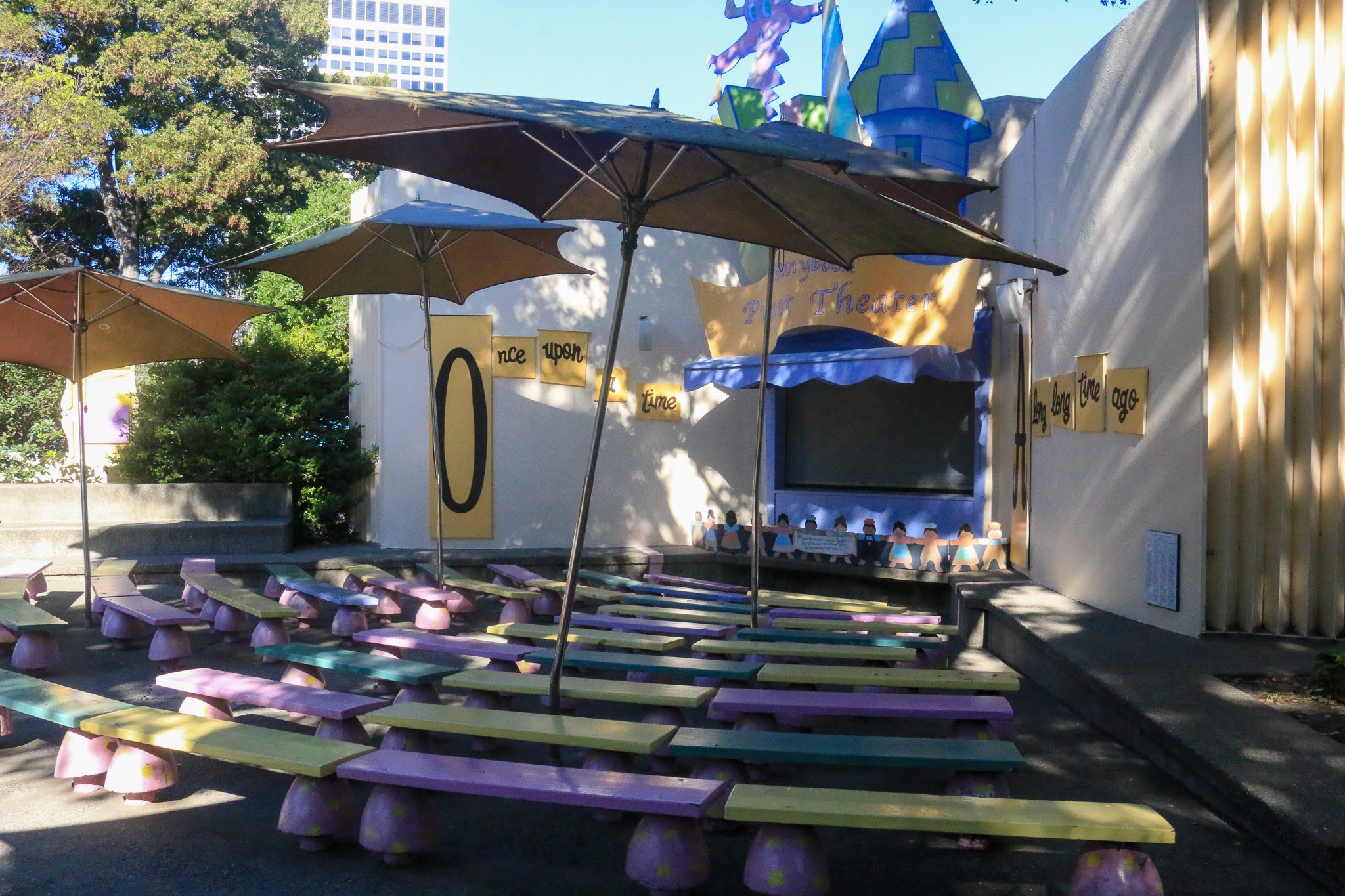
“We are now more diverse than any other time in my life,” Metz said. “We have to be in step with our communities because they like to see that their cultures are represented. … We are not just the old-fashioned Disney-type European fairytales.”
Metz said his predecessor, Lewis Mahlmann, would look during his travels for stories and costumes he could adapt and bring to the theater.
“The only difference now is that we are very specifically working with the culture to make sure we’re not putting our own interpretation on their story,” Rodriguez said.
That evolution is also visible in Fairyland’s bilingual programming, including bilingual storytelling boxes that have been narrating in English and Spanish since 2009. Spanish is increasingly heard throughout the park, among visiting families, and Fairyland has been working to reflect that shift.
Fairyland’s last bilingual puppet show, “How the Coquí Got Their Name,” a Puerto Rican folktale that ran through May 28, was especially well-received, Rodriguez said.
Rodriguez, who grew up in a Cuban immigrant household, said the goal was not to offer literal translations, but to weave both languages together naturally within the story’s rhythm.
“It was just so important to me to bring a story that could be understood easily in both languages without being repetitive,” she said. “I didn’t want it to just be one line in English and then the same line in Spanish.”
That approach has resonated with audiences, and particularly with bilingual families who, she said, have appreciated the representation.
“We have people from Puerto Rico who literally ran into the gift store,” Rodriguez said. “They’re like, ‘Oh my gosh, you’re doing a story from Puerto Rico. That’s where I’m from. I’m so excited.’ You don’t get that with Cinderella.”
For many children visiting Fairyland, the show may be the first time they encounter a story tied directly to the Indigenous people of Oakland.
“Hopefully they’ll know the story originated here,” Gould said. “This story is from here.”
For Oakland second-hand shoppers, the White Elephant rummage sale is like Black Friday
Oakland North welcomes comments from our readers, but we ask users to keep all discussion civil and on-topic. Comments post automatically without review from our staff, but we reserve the right to delete material that is libelous, a personal attack, or spam. We request that commenters consistently use the same login name. Comments from the same user posted under multiple aliases may be deleted. Oakland North assumes no liability for comments posted to the site and no endorsement is implied; commenters are solely responsible for their own content.