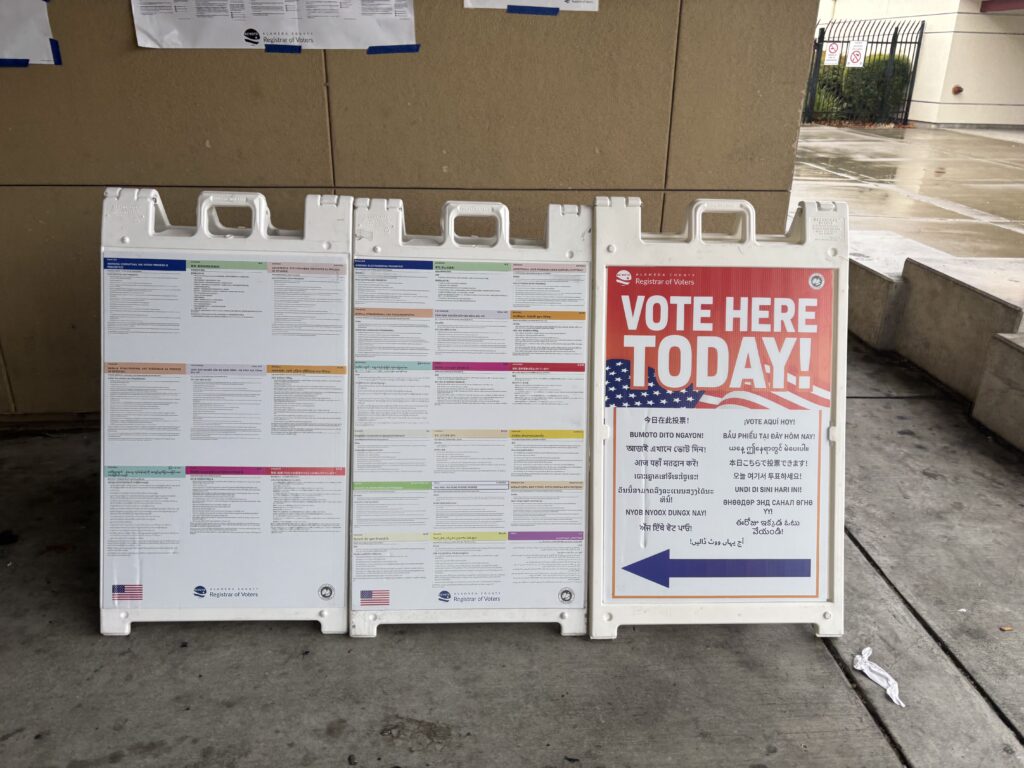
Election Day coverage: Reporting all day from Oakland polls
on November 3, 2026
In the basement floor of René C. Davidson Courthouse, in a room marked “Employees Only,” Alameda County elections workers sit in rows at 20 desks, facing each other, a computer in front of each worker. It’s Election Day, the longest day of the year for these workers. For fuel, overnight oats and banana bread litter the desks. For sanity, soft country music plays in the background — the only sound besides the clicking of computer keys.
“We try to make it smoother, and we tried different kinds of music because it’s going to be a long day,” said Cynthia Cornejo, interim registrar of voters.
Workers are busy verifying voter signatures. On their screens are three columns — the first lists the voter’s name, the second shows a scan of the signature on the returned envelope, and the last shows the signature on file, usually from voter registration or motor vehicle records. The staff was trained weeks earlier to look for abnormalities and differences in signatures. They flag any suspicious signatures, which then go to supervisors for further review.
There is a maze of doors in the bowels of the courthouse. The ballot opening room looks exactly the same as the others. But observers must stay behind large glass walls, beyond which, two monitors show the opening and scanning processes. It’s a warehouse-like space, where 44 workers are sorting ballots into blue, green, and red bins. Blue bins hold ballots waiting to be extracted from vote-by-mail envelopes. Green bins hold the ballots ready to be scanned. Red bins hold ballots that need further research and may be sent to adjudication.
The scanning takes place in a separate room that is kept off-limits. But monitors do show tons of ballots being pushed into the L-shaped scanning machine. Scanned ballots are then collected by staff and put on a separate shelf.
Remakes and adjudication took place in a separate part of the building, hidden behind another door inside the office. This was perhaps the most vibrant workspace, with staff members working in pairs.
For ballot remakes, workers create a scannable duplicate when an original ballot is damaged, misread, or otherwise could not be processed normally.
For adjudication, a reviewer and a checker examine ballot images flagged by the scanning system to determine the voter’s intent. Their decisions are then reviewed at another level before a ballot is submitted.
To keep the ballots safe, there is a designated water bottle station so nothing spills on the ballots.
Reporter: Siyu Pan
At the polls
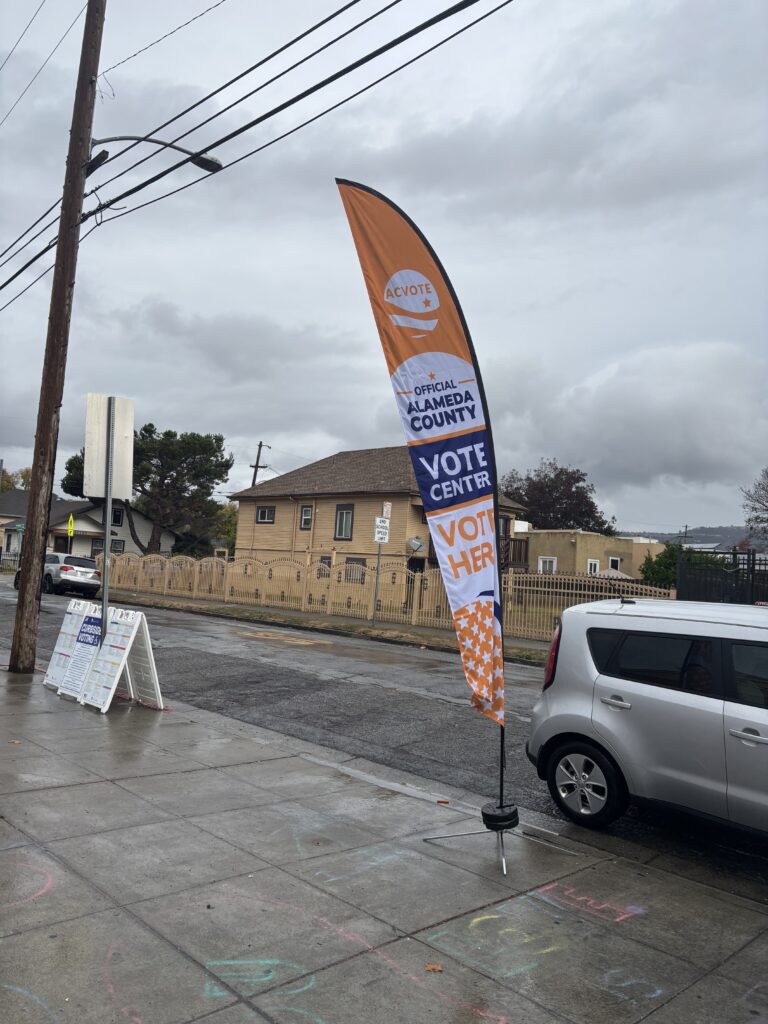
Cloudy skies greeted early morning voters in Oakland, where the forecast on Election Day called for rain throughout the day.
Oakland voters will be casting ballots for mayor, city council and school board, as well as considering a charter change that would bring a new form of government.
Incumbent Mayor Barbara Lee is running for reelection against three challengers: Brenda Grisham, Mindy Pechenuk and Julius Robinson.
Council President Kevin Jenkins is trying to hold onto his District 6 seat, against opponent Nancy Sidebotham.
District 2 City Council incumbent Charlene Wang is hoping to fend off a challenge by Nate Adams.
Oakland Unified School District board President Jennifer Brouhard is seeking another four years, with Arielle Fleisher challenging in District 2.
Mike Hutchinson, a six-year incumbent, is running against Kathryn Camp in District 4. And incumbent Valerie Bachelor has two District 6 challengers — LeAna Powell and Alexandra Williams.
Oakland City Council is asking voters to change the city charter to give the mayor veto power and the City Council power to override a mayor’s veto. The change would bring a strong mayor form of government to Oakland, with the mayor appointing and having direct authority over department heads.
Voters also will decide if the city should amend its property transfer tax by removing the exception on foreclosed properties, which would generate $4 million to $13 million annually.
Oakland North will be at the polls, talking to voters about issues important to Oakland residents. This report will be updated throughout Election Day.
5:45 p.m
Ryan Ghiglieri, 32 and Savannah Carter, 33, both felt it was tough to decide how to vote on measure EE.
“We were on the fence,” Ghiglieri said.
On one hand, Ghiglieri said the city has problems, and he doesn’t know if the system works. But he also doesn’t know if changing the system is right either. Carter said sometimes the mayor can get things done faster.
“But then where are the checks and balances?” she said.
Both ended up voting yes for the measure.
Reporter: Cadence Quaranta
5:38 p.m
There has been a line out the door for hours as people wait to cast their vote at the Oakland Public Library. At one point, those exiting the polling station were met with voters waiting in line with cheering. On three nearby street corners, supporters of Nate Adams and the regional transit measure held signs and talked to voters approaching the polling station. Councilmember Charlene Wang was there, too, talking to people around the polling station.
Reporter: Cadence Quaranta
5:30 p.m.
Camille Dunne, 27, who lives in Bella Vista, feels strongly about the contested District 2 Oakland School Board race and cast her ballot for Arielle Fleisher. As a parent with a child in an Oakland public school, “She sees the problems,” Dunne said.
She said she is voting in the interest of her child, and says she wants to secure a better education for them.
Reporters: Maya Reyes and Cadence Quaranta
Gabriel Agurcia, 33, said he voted yes on Proposition 40. He believes people who make a lot of money avoid giving back to society.
“They have to give their fair share,” he said.
Agurcia said he can’t wrap his head around a billion dollars and feels if people with that much money aren’t willing to help people with less, it’s selfish.
Reporters Cadence Quaranta and Fiona Hastings
4:35 p.m
With the many measures and propositions on the ballot, James Bull, 76, an East Oakland resident, has spent more time than usual voting this year. Bull carried his voting handbook with him as he made his way to the voting hall at Allen Temple Baptist Church. While he remains unconvinced about ranked-choice voting, he is certain about one thing: supporting all measures endorsed by Democratic Sen. Bernie Sanders.
For other voters, this year’s election carries a heightened sense of importance. Allim Moor, 62, said the stakes feel higher than in previous years. Moor supports incumbent Mayor Barbara Lee, citing her integrity, experience and commitment to Oakland. “I trust and believe in what she believes in,” he said.
George Holland, 85, head to toe in a grey sweatsuit a nod to the gloomy weather, also expressed support for Lee, praising her leadership, 23 years of experience and connection with the community. “She wants everybody to be respected and everybody to have equal chance,” he said.
For Kaila Mathis, 31, this election represents something even greater. With so much at stake, Mathis described voting as a full-circle moment, reflecting on the struggles of previous generations of the black community to secure the right to vote.
“Knowing that in 1965 our people were fighting for our right to vote, and now it’s being threatened,” Mathis said. “I think right now, we’re really, really voting for our freedom.”
Reporters: Yuan-Hsi Chou and Reya Hart
4:15 p.m
For Kevin Rodriguez, 27, a resident of East Oakland, Proposition 40 is his biggest issue this election day. He is a registered nurse and is studying to be a nurse practitioner.
He sees deficits in what providers should be offering patients, especially in areas such as psychological, mental health and reproductive healthcare. He believes money generated from Prop 40 should be directed towards those areas.
“It’s time that people pay their fair share,” he said.
Rodriguez also feels strongly about the Regional Transit Measure, as he takes BART to school every day. He believes BART and other transit systems need funding.
“BART is an integral part of communities,” he said. “It’s so helpful for so many people.”
Another concern for Rodriguez is what traffic would be like if BART were to cut lines, causing commutes to be longer and requiring riders to drive further to BART stations.
Reporter: Cadence Quaranta
4:01 p.m
Adams has been canvassing in front of the Oakland Public Library, speaking to voters and shared a profound moment with a resident who hadn’t voted in 30 years but decided to cast their ballot after speaking to him.
“I was telling her that I agree the system isn’t working for working people and it hasn’t for a long time, and right now we’re at a historic moment, just in the past two years or so, something activated in people where people are coming together,” Adams said.
Starting at 8:00 PM the DSA will host an Election Night Watch Party at the Double Standard along with Adams who will attend and watch the results with everyone there as they come in.
Back at the Democratic Socialists of America’s East Bay Headquarters, Campaign Chair Shiva Mishek was in her office hopping from her phone to her computer, looking over the day’s work.
The day’s plan for the Adams campaign includes door knocking at apartment complexes in the Brooklyn Basin, Chinatown, Jack London and Lakeshore neighborhoods, and phone banking identified supporters and undecided voters in multiple languages. According to Mishek, working people should be represented by someone who understands what it is like to be an average Oakland resident who is struggling with affordability.
“I think that having someone like Nate who went from being a DoorDash driver to a community organizer does actually impact the way he’ll represent people in Oakland,” she said.
Adams’s life may or may not change today, but his final pitch to voters is to imagine how Oakland could improve for working people and to believe in him as part of the solution.
Reporter: Eric Urbach
4 p.m.
Proposition 40 is the most important issue on the ballot for Nina Hankins, 28, because she feels it would help with growing income inequality. She hopes the money from the tax will go to housing, social services, and public education.
“This is what made me show up to vote,” she said.
Reporter Cadence Quaranta
3:52 p.m
Zo Amaro Jimenez, 35, recently moved to Oakland from Los Angeles and voted at the Oakland Public Library. They want local government to prioritize residents who are struggling to afford to stay in the city.
“As someone who is a transplant from Los Angeles, I wanna contribute to a local government that is taking my money so that the people who’ve grown up here and are native to here get to stay,” they said.
Jimenez voted for incumbent Mayor Barbara Lee, saying they trust her more than the other candidates.
“I wouldn’t say I really believe her wholeheartedly. I don’t think I believe any politicians wholeheartedly. But I believe her more,” Jimenez said.
Jimenez said they felt anxious about the election despite it not being a presidential contest, particularly because of concerns about economic inequality.
“I definitely cared a lot about the billionaire tax,” they said. “I think a lot of the people who desperately need a lot of support are the ones that are supporting a lot of social programs.”
Jimenez said they believe wealthier residents should contribute more to programs that support people in need.
Reporters: Maya Reyes, Wuendy Calmo
3:30 p.m.
In the contested District 2 councilmember race, Kenneth Steele, 77, said he effectively cast a “protest non-vote for inaction,” writing down his own name. He didn’t feel either candidate could get the things done that are needed in his neighborhood.
Steele has lived on Hanover Avenue since 1986. For years, he said his street has needed to be paved. It has potholes that need to be filled. But generations of District 2 councilmembers have done nothing.
“All I want is for my street to be paved,” he said. “I don’t think they would make that a priority.”
Reporter Cadence Quaranta
2:22 p.m
Akeisha Flood was one of the few people outside the BART Station on 19th St, waiting near the NL line in the rain. She has not used public transport for over 17 years now, but has had to since her car broke down in TK month.
If the Regional Transit Measure doesn’t pass, Flood is concerned that route and timetable changes will make it very inconvenient for her and others to get around.
“It’s going to be a hassle for a lot of people,” she said.
Flood, who was born and raised in Oakland, said a lot of people in her circle are discussing the measure but also said she avoids talking to people about political issues because she wants to avoid conflict.
Reporters: Nichelle Wong, Mary Mijares
BART rider Akeisha Flood at 19th St. BART
(Audio reporters: Nichelle Wong & Mary Mijares)
12:41 p.m
Demarco Jeffrey googled the Regional Transit Measure (RTM) for the first time when he saw it on the ballot. A resident of Oakland at Seminary Ave and Foothill Blvd, Jeffrey voted at TK location in District 6.
Jeffrey was concerned that if the RTM didn’t pass, it would mean slower train times, fewer trains and more crowded trains. Jeffrey was also concerned about not being “safe on the BART.”
Reporters: Nichelle and Mary
Noon
Moments before U.S. Rep. Lateefah Simon arrived to vote at East Oakland’s Allen Temple Baptist Church on International Boulevard, the lead poll worker rushed across the hall, telling members of the media to shut their cameras off because of a new ordinance limiting recording in polling places. Reporters and photographers protested, saying they had clearance from the registrar and that they had never before had limitations on what and where they could record.
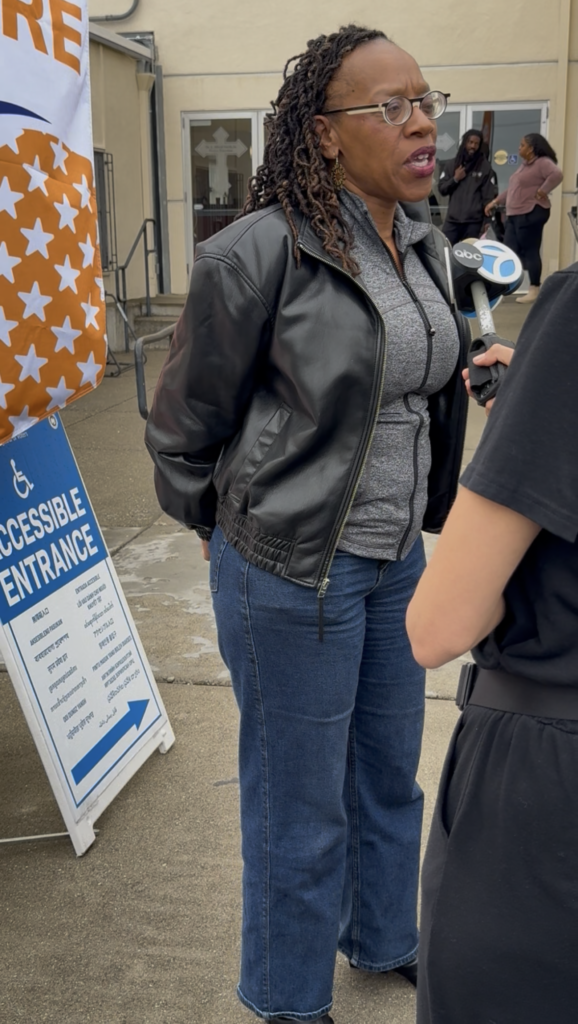
Amid the dispute, Simon entered the hall alongside a small entourage of staffers, wearing a leather jacket and jeans. She was greeted by an excited poll worker who told her, “I’m so glad you’re here.” She responded with a hug saying, “I’m so glad I’m here too,” before taking a seat behind the partition to vote.
As the cameras were packed up to move outside, Simon poked her head out of the partition and yelled across the hall to the line of voters and press,
“I voted for myself,” she announced.
Simon, who is wrapping up her first term in Congress, is fending off a challenge by Jamie Joyce, of Berkeley.
While at the polls, Simon urged voters not to be intimidated by U.S. Justice Department monitors, the election monitors deployed to conduct election oversight.
Reporter: Reya Hart
11:48 a.m
Cameron Johnson, 29, accompanied his partner to the 81st Avenue Branch Library, still dressed in his pajamas. An Oakland resident for more than two decades, Johnson was excited to vote despite the heavy rain and cold.
He wants whoever wins the election to address violence, damaged sidewalks and other problems. But he also believes some Oakland residents are wary of improvements because they fear being displaced.
“We want so much great to happen to us, but then we’re, like, ‘No, but we don’t want this much to happen to us, ’cause then they’re gonna try to push us out,’” he said.

This was Johnson’s second time voting, and he said he believes voting is how change happens. Unlike the last time he voted, he said, more candidates on the ballot seemed relatable to him.
Johnson said he voted for incumbent Mayor Barbara Lee because she is Black.
“I want to see my people shine. Our environment, we need that,” he said.
Reporters: Rachel Ababio and Duha Hmidan
11:42 a.m
Aniah Willis, 21, had already mailed her ballot but came to the 81st Avenue Branch Library to encourage her partner to vote.
“This is the one election that our voices really, really, really matter,” Willis said.
Willis is most concerned about the school board race. Having grown up on 73rd Avenue in East Oakland, “right around the corner,” she has noticed disparities between schools in the Oakland Unified School District and those in neighboring cities, including Berkeley and San Leandro.
Willis attended Castlemont High School before transferring to San Leandro High School.
“When I got to SL, they had a plethora of programs for people to do things, sports and everything,” Willis said. “When you’re really in Oakland, you see that these students get less funding, we get less programs.”
Willis said she wants school board members who grew up in Oakland and understand the inequities students face.
She is also concerned about public safety.
“When you call the cops in Oakland, you’re waiting 40 minutes for them to get there,” Willis said. “So it better not be an emergency, because you won’t get any help.”
Reporters: Rachel Ababio and Duha Hmidan
11 a.m
Freida Rose Lee, 73, came to the voting poll at 81st Avenue Branch Library to vote for her grandkids’ future.
Education is her top concern.
Lee is worried about bullying at schools and what she perceives to be a general lack of respect and wants whoever is elected to the School Board to address that.
Lee also says things have changed in Oakland since she was a girl, with an increaseincrease in crime rates, trash, and potholes.
“I want to see my children and my grandchildren succeed.”
Reporters: Rachel Ababio and Duha Hmidan
Prop 40
Some Oakland voters expressed enthusiasm Tuesday morning for Proposition 40, which would impose a one-time 5% tax on the wealth of California billionaires. If approved, it would be the first tax of its kind in the country.
Jessica Ramirez Jefferson, 53, a lifelong East Oakland resident who voted at the 81st Avenue Branch Library, said she believes the proposition could help reduce income inequality.

“We have too much of a differentiated line,” Jefferson said. “That is, you’re either broke or you’re super wealthy. There’s not much in between.”
Jefferson pointed to the stark contrast between the region’s millionaires and billionaires and its many residents experiencing homelessness.
She also said she hopes the measure could help fund struggling city services, including road repairs.
“If it does pass, then I do feel like it could help out our communities a lot,” she said.
Fruhar Safa, who moved to the East Bay five months ago, also supports the proposition. She spoke from inside the 19th Street Oakland BART station.
“About time,” she said.
Safa said growing wealth inequality has consequences for society and that the measure could generate revenue for public services. But she said the proposal falls short because it imposes only a one-time tax.
Oakland resident Joey K. said she supports the proposition because she believes it would help improve living standards. She pointed to the 1980s, when she said higher tax rates were associated with a higher standard of living.
Reporters: Mary Mijares, Duha Hmidan, Rachel Ababio
10:30 a.m
District 2 incumbent Charlene Wang plans to spend part of Election Day outside the polling place at the Jack London Aquatic Center, according to her chief of staff, Michael Wimsatt.
Wang will join other incumbents seeking re-election, including Mayor Barbara Lee, District 6 Council President Kevin Jenkins and District 4 Councilmember Janani Ramachandran, at an election night party at Fluid510 at 7 p.m.
Around the corner from the East Bay Democratic Socialists of America headquarters, Oakland residents at a local coffee shop shared their thoughts about the election.
District 2 resident Dennis Orason said that while Wang has made efforts to improve the quality of life in her district and across Oakland, he plans to vote for her challenger, Nate Adams.
“I feel deeply that endorsing Flock and contributing to a more surveilled state is not what I want in Oakland and that’s why I’m voting for Nate Adams,” Orason said.
Standing out in the sprinkling rain in a crowded Trader Joe’s parking lot on Lakeshore Drive, a moderately wet Joyce Ching was handing out flyers from a thick stack of campaign materials for incumbent Charlene Wang.
“She’s got a lot of experience,” Ching said. “She knows what she’s talking about when it comes to public policy, what comes out of her speeches is mainly just solutions, so she’s very much solutions based.”
Reporter: Eric Urbach
10:22 a.m
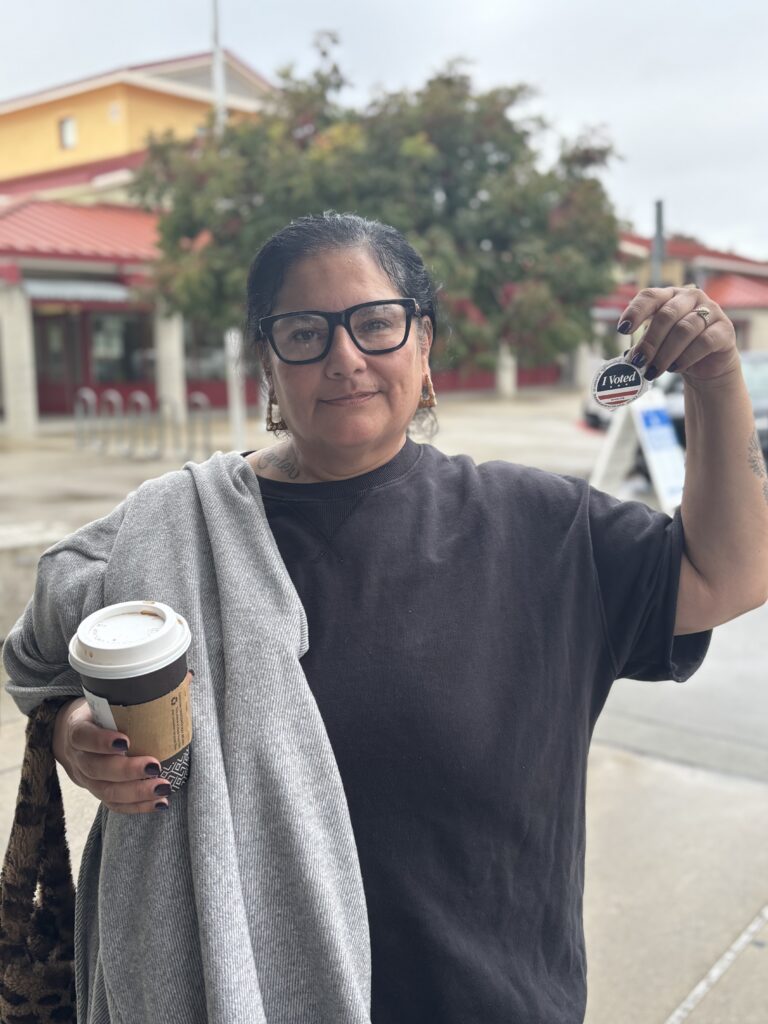
Jessica Jefferson, 53, arrived at the 81st Avenue Branch Library with a cheetah-print purse in one hand and coffee in the other.
A lifelong East Oakland resident, Jefferson wants elected officials to be accountable to their constituents and address issues affecting their daily lives.
One of her biggest concerns is the impact of U.S. Immigration and Customs Enforcement on Oakland residents. She said the election would be a “good start” toward challenging what she described as the agency’s unlawful actions.
“It’s extremely aggressive, combative, and it’s hurting our community,” Jefferson said. “If you’re a citizen, if you’re a refugee, I don’t care. You deserve dignity and humanity.”
Jefferson, a teacher, said the school board elections are equally important. She believes it is time to stand up for students, parents and teachers.
“It’s very hard as a teacher to be able to make a difference and an impact in their community, and be there for kids at school when they don’t have resources,” she said.
Proposition 40, a proposed tax on billionaires, is also among Jefferson’s priorities. She pointed to the region’s income inequality, contrasting its wealthy residents with the many people experiencing homelessness.
She believes the measure could help reduce those disparities and improve local communities.
Reporters: Duha Hmidan, Rachel Ababio
9:48 a.m
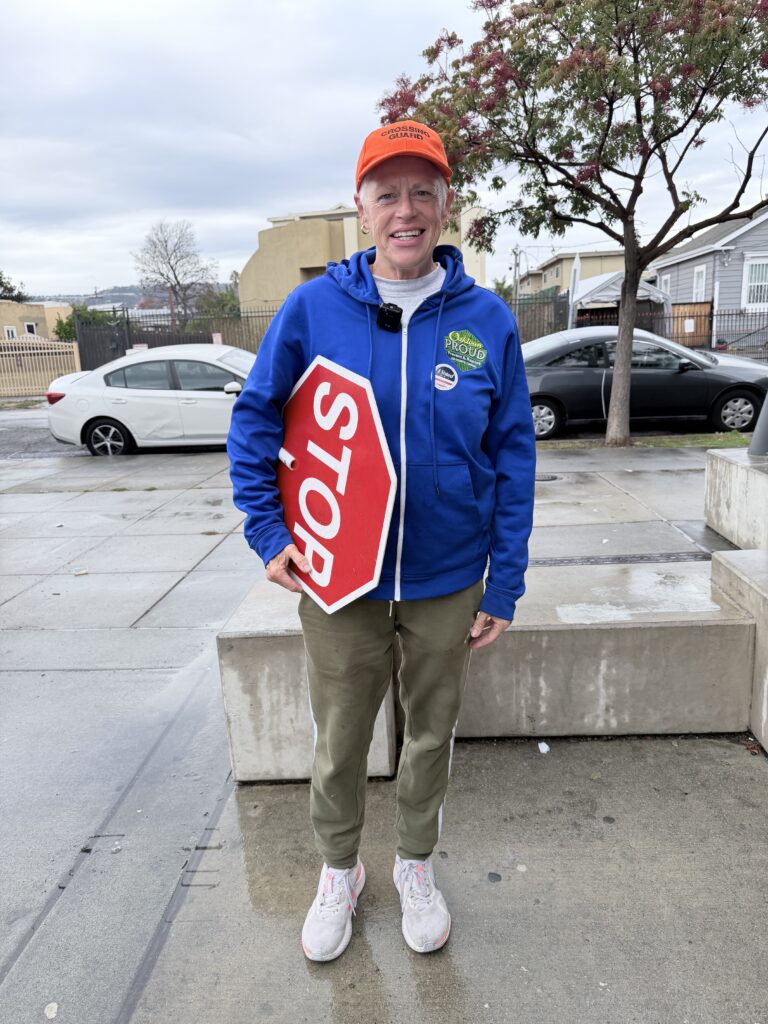
Lisa Ruhland, 64, works as an Oakland crossing guard and voted at the 81st Ave Branch Library. She has been living in Laurel for over three decades and said people rely on public transportation to get to school, to work, to the doctor’s office.
For her, it’s essential that the Regional Transit Measure pass.
“I want us to pay the sales tax to keep it afloat,” Ruhland said. “I understand that there’s so much waste, and I understand all those agencies are so inefficient, but that doesn’t mean we can afford for them to cut lines.”
The measure would add a half-cent sales tax in Alameda and other counties to raise additional funding for transit systems, which have warned they may have to scale back on services if they aren’t able to get additional funding.
“Everyone needs to be able to get where they want,” she said.
Reporters: Duha Hmidan, Rachel Ababio
8 a.m
Outside the El Cerrito del Norte BART station, three people canvassed for a regional transit measure, holding signs and handing out flyers. A man riding his bike to catch the train shouted, “Thank you for your work.”
The proposed regional transit measure would increase sales taxes to raise nearly $1 billion for transit agencies, including BART, AC Transit, Muni and Caltrain, which face budget shortfalls and potential service cuts.
Fruhar Safa, who moved to the East Bay five months ago, said it was time to pass Proposition 40, California’s proposed billionaire tax, after “seeing such visible signs of what happens when we allow wealth disparity to grow.”
Chao Tsung Yang, who was born in Taiwan, has lived in Oakland for eight years. Riding BART is part of his daily routine.
Yang supports the regional transit measure but is uncertain whether it would lower fares. He contrasted transit in the Bay Area with Taiwan, where he said public transportation is more affordable and accessible.
Reporter: Mary Mijares

Oakland North welcomes comments from our readers, but we ask users to keep all discussion civil and on-topic. Comments post automatically without review from our staff, but we reserve the right to delete material that is libelous, a personal attack, or spam. We request that commenters consistently use the same login name. Comments from the same user posted under multiple aliases may be deleted. Oakland North assumes no liability for comments posted to the site and no endorsement is implied; commenters are solely responsible for their own content.